TL;DR
Most shampoos share the same cleansing base. The differences come mostly from added ingredients that make a formula lighter (for oily or fine hair) or richer (for dry or damaged hair). Volumizing, moisturizing, anti-frizz, repair, and color-safe shampoos do have real formulation tweaks, but the effects are usually modest and marketing often overstates them. Medicated shampoo (anti-dandruff, for example) is the one big exception, because it contains proven active ingredients. Pick a shampoo that matches your scalp and hair type; the label and the price matter much less.
What every shampoo has in common
Every shampoo has the same basic job: cleaning oil, dirt, and product buildup off the hair and scalp. So most shampoos share the same base. A typical shampoo is about 80% water and about 15% detergents (surfactants), with additives making up the rest[1]. The surfactants do the cleaning. One end of the molecule attaches to oil and the other to water, so grease and debris get emulsified and rinse away[2]. Common ones include sulfates like sodium lauryl sulfate (SLS) and sodium laureth sulfate (SLES), which lather richly and remove oil well[3].
Where shampoos differ is in the extras added on top of that base[4]. Manufacturers add conditioning agents, proteins, oils, polymers, fragrance, and specialized ingredients to target particular hair “needs” or to create a certain feel in use. How these are balanced (stronger cleansers or more moisturizers, for example) determines how a shampoo feels and performs on different hair types[5][6].
Each formula also has to clean well without stripping all of the hair’s natural oil or damaging the hair fiber[7][8]. So even clarifying shampoos often include milder secondary surfactants or a little conditioning agent to soften their harshness, and even moisturizing shampoos still contain enough cleanser to avoid residue. The differences between types are a matter of degree and formulation detail.
How shampoo types differ
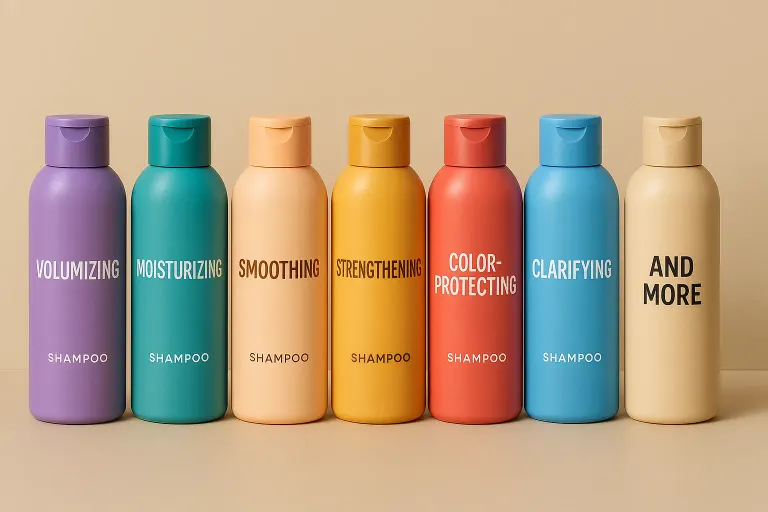
Shampoos are sold for all sorts of purposes: volumizing, moisturizing, smoothing, strengthening, color-protecting, clarifying, and more. Many of these come down to two broad formulation strategies[4][9].
The first is a light, cleansing-focused formula for oily, fine, or limp hair, often labeled volumizing, clarifying, oil-control, balancing, or thickening. These shampoos use stronger surfactants and few conditioning additives, so nothing is left behind to weigh the hair down[10]. The hair ends up very clean and light, which can help volume. Some also deposit a thin film of a polymer (e.g. panthenol or certain proteins) that thickens the hair shaft slightly without adding weight[11].
The second is a rich, conditioning-focused formula for dry, damaged, or thick hair, often labeled moisturizing, hydrating, smoothing, anti-frizz, strengthening, color-care, and so on. On top of the basic surfactant system, these contain conditioning agents (like silicones, natural oils, fatty alcohols, or vitamins) that are meant to stay on the hair[9]. The coating they leave after rinsing flattens and seals the cuticle (the shingle-like outer layer of the hair), and a smoother cuticle makes hair feel softer, look shinier, and frizz and tangle less[12]. On dry or chemically treated hair, that coating also works as a protective layer. The trade-off is that a formula too rich for fine hair can leave it feeling heavy or greasy.
Beyond those two camps, the differences between specific categories are often subtle. One cosmetic scientist says that apart from clearly separate types (like anti-dandruff versus regular shampoo), these are the only two fundamental categories. Within each one (among volumizing shampoos, say, or among moisturizing ones), the scientist says, “there is nothing out there that is so different that your hair will greatly benefit from it”[13]. Each category still has some typical ingredients, and the evidence behind its claims varies.
Volumizing and thickening shampoos
Volumizing shampoos promise fuller, thicker hair with more lift at the roots. They are aimed at fine or limp hair that lacks body.
Volumizing formulas are deliberately lightweight, with efficient cleansers and minimal conditioners. Heavy oils and silicones that could flatten the hair are left out, and any added polymers are chosen to give lift without weight[14]. Many include hydrolyzed proteins, panthenol (pro-vitamin B5), or cellulose derivatives that leave a thin coating on each strand and temporarily plump the hair shaft[11]. Some even use starches to boost thickness[14]. Each fiber gets only microscopically wider, but across the whole head that adds up to more volume. These shampoos also often leave the hair with more texture (a bit of coarseness), which increases friction between strands and helps styles hold.
Do they work? To an extent, yes. Because they remove oil and buildup thoroughly and don’t deposit the usual conditioning film, they prevent the “drooping” that heavy products can cause on fine hair. The thin coating from panthenol or protein also adds a little shine as well as diameter[11]. The improvement in lift and fullness is modest and shows most on naturally very fine hair. No shampoo can change your hair’s actual density or create new strands, though. The volume is cosmetic and temporary, and you often need styling products on top to get the most out of it.
Clarifying (deep-cleansing) shampoos
Clarifying shampoos (also called “deep-cleansing” or sometimes “detox” shampoos) claim to remove stubborn buildup from hair, such as leftover hairspray, silicones, hard-water minerals, or excess oil, more thoroughly than regular shampoos. The promise is a “squeaky clean” reset.
Clarifying formulas use stronger surfactants or higher concentrations of them, often sulfates like ammonium lauryl sulfate or sodium laureth sulfate, to dissolve oils and product residues aggressively. They usually contain little or no conditioning agent, which puts them at the far end of the cleansing-focused spectrum. Some include chelating ingredients (e.g. EDTA, citric acid) that bind mineral deposits from hard water so they wash away. Many also have a higher pH, which helps cleansing but can lift the hair cuticle slightly. Without the usual smoothing additives, clarifying shampoos can leave hair tangly or dry unless you follow with a conditioner.
They do remove buildup more vigorously than regular shampoos, for the basic chemical reason that a stronger detergent cleans more aggressively. If you have used one, you will know the almost rough, very clean feel your hair has afterward (all the oil is gone). They are a good fit for very oily scalps and heavy product users[15], but used too often they can dry out the scalp[16]. Because they can strip natural oils and the protective lipid layer from the hair, overuse can also lead to dryness, frizz, and color fading (especially on chemically treated hair). A review of hair cosmetics advises using clarifying shampoos sparingly, such as once every 1-2 weeks, and avoiding them on bleached hair, which is very porous and vulnerable[17].
Moisturizing and hydrating shampoos
Moisturizing shampoos promise to hydrate dry hair and make it softer, shinier, and easier to manage. They are meant for hair that feels dry, brittle, or coarse, and are often recommended for curly, thick, or chemically treated hair that lacks moisture.
Moisturizing formulas contain a lot of conditioning and emollient ingredients. Alongside milder cleansers, they include natural oils (argan oil, coconut oil, jojoba), butters (shea butter), fatty alcohols, silicones (e.g. dimethicone), and humectants (glycerin, aloe). Many look creamy and pearlized because of the added fatty compounds. A thin film of these agents stays on the hair after rinsing and restores the slip and softness that washing can take away. Shampoos marketed as “hydrating” often deposit oils or silicone that flatten the hair cuticle, so the hair feels smoother and looks glossier[12].
Because they leave more residue by design, these shampoos tend to feel heavier. They may also lather less, since oils suppress foam (some people associate big lather with “stripping” shampoos and creamy, low lather with moisturizing ones). Moisturizing shampoos are often formulated at a slightly acidic pH (about 5), which helps keep the cuticle closed and makes the hair smoother still. They are close to a shampoo and conditioner hybrid, with conditioning first and basic cleansing still included.
The lubricating film they leave on the strands reduces friction and frizz (hair combs more easily and doesn’t puff up as much)[18][19]. The oils and silicones work much like a light leave-in conditioner. Coconut oil can even penetrate the hair shaft and reduce protein loss from the hair during washing[20]. A shampoo containing coconut oil (or something similar) could therefore help strengthen hair over time by limiting the damage that builds up from repeated swelling and drying. Oils that do not penetrate (like mineral oil) can still form a film that adds shine and reduces friction, which helps prevent breakage[21][22].
People with naturally dry or textured hair (many curly-haired people, for example) often say moisturizing shampoos leave their hair noticeably softer and less tangled than regular shampoos. Byrdie’s shampoo guide says curly and thick hair does best with very moisturizing shampoos that have frizz-reducing ingredients, ideally ones that don’t weigh the curls down too much[23]. The one caution is very fine or low-density hair, where the leftover oils and butters can make the hair look limp because the “moisture” is simply too much.
A moisturizing shampoo can’t hydrate the hair’s inner cortex with water (hair is dead and can’t really be “hydrated” from the outside in). It coats the hair to lock in moisture and smooth the surface, which is enough to make the hair feel hydrated.
Smoothing and anti-frizz shampoos
Smoothing or anti-frizz shampoos are meant to tame frizz, flyaways, and unruly hair, and often promise sleeker hair that resists humidity. They are aimed at hair that puffs up in humid weather, has a rough texture, or is prone to static and tangles (common in curly, wavy, or chemically damaged hair).
These formulas overlap with moisturizing shampoos but are tuned specifically against frizz. Frizz happens when the hair cuticle is raised or damaged and when hair absorbs moisture from the air unevenly, so strands swell and stick out. Dryness and excess negative charge on the hair make frizz and flyaways worse. When hair is washed with strong anionic (negatively charged) detergents alone, the negative charge on the fibers increases, so they repel each other and look fluffy or frizzy[24][26].
Anti-frizz shampoos counter this by smoothing the cuticle and reducing static. They usually contain silicones (like dimethicone or amodimethicone), which are very good at coating the hair and sealing down the cuticle scales[12]. They also include cationic polymers or quaternary ammonium compounds (often listed as Polyquaternium-# or guar hydroxypropyltrimonium chloride). These carry a positive charge and cling to the negatively charged hair, and together with the silicones they neutralize the static and reduce frizz and flyaways[24][25][27]. Many anti-frizz formulas are sulfate-free or use a low-pH surfactant system, because a lower pH helps keep the cuticle tight and smooth. Humectants like glycerin or propylene glycol can help regulate the hair’s moisture content so it doesn’t grab water from humid air.
One beauty chemist says frizz-fighting formulas should contain “advanced humectants like glycerin or hyaluronic acid, low-pH surfactant systems, and anti-static agents to help smooth the cuticle”[28], which is what many anti-frizz shampoos do. Silicone in particular has been shown to protect the hair shaft from moisture fluctuations and mechanical damage, which weatherproofs the hair to some degree[29][30].
People who use anti-frizz shampoos often find their hair sleeker after washing than with a normal shampoo, because of the smoothing residue these formulas leave. That gives you a smoother starting point, but no shampoo makes hair immune to frizz on a humid day, and very frizz-prone hair usually needs styling products or serums as well. Take claims of “72-hour frizz protection” on some products with a grain of salt (they probably assume you don’t wet or wash your hair again in that time).
Repair and strengthening shampoos
Shampoos labeled repair, strengthening, damage-repair, or fortifying suggest that they can mend split ends, reinforce weak or brittle hair, and restore strength lost to damage. They are aimed at hair that has been chemically processed (bleached, permed) or heat-damaged and may break easily.
These shampoos often contain ingredients that bond to the hair’s protein structure or fill gaps in the hair shaft. Common additives (which standard shampoos may not have) are hydrolyzed proteins (keratin, collagen, wheat protein, silk amino acids) and peptides. These protein fragments are small enough to stick to the cuticle and even penetrate slightly into the cortex where the hair is damaged[31][32]. The idea is that they patch microscopic damage, a bit like spackling a cracked wall. They usually carry a positive charge, which helps them stick to the negatively charged, damaged parts of the hair[32]. Besides proteins, strengthening shampoos may have ceramides or other lipids that mimic the hair’s natural cell membrane complex and are meant to cement the cuticle cells together. They usually have some conditioning ingredients too, since damaged hair also tends to be dry, but they lean on protein more than heavy oils.
Some newer “bond rebuilding” shampoos, inspired by treatments like Olaplex, include proprietary molecules (for example polyfunctional compounds like maleic acid or succinic acid) that are claimed to reconnect broken disulfide bonds inside the hair. They might help a little with keeping hair strong, but a shampoo is only in contact with the hair briefly, and independent studies are sparse. At best they supplement more concentrated treatments. Caffeine, biotin, and panthenol are also often advertised in this category. Caffeine is there for possible scalp stimulation (the evidence on hair growth is limited). Biotin is mostly a marketing buzzword, since topical biotin doesn’t strengthen hair unless there’s a deficiency. Panthenol has a known film-forming and strengthening effect.
No shampoo can really “heal” a shattered hair shaft or permanently seal a split end back together. Once hair is damaged, especially if the inner cortex is exposed, the damage can’t be undone except by cutting the hair. Keratin has a unique protein structure, and while amino acid blends can mimic parts of it, they “do not replace or restore the damaged molecular structure” of your hair’s keratin once it’s broken[34].
What shampoos can do is improve the cosmetic condition of damaged hair, because hydrolyzed proteins deposit on it and reinforce it temporarily. In one study, low molecular weight hydrolyzed keratin from feathers deposited on the hair cuticle and helped seal it, especially after heat was applied, which improved hair strength and shine[33]. These proteins built up more on highly processed (bleached) hair, which is more porous and gives them more to cling to, and by neutralizing the hair’s negative charges they also reduced frizz and friction[32]. Studies have also found less breakage or higher tensile strength with repeated use[35], and people often find that a good strengthening shampoo makes their hair less likely to snap during combing. The deposited proteins wash out gradually, which is why these shampoos work best with continued use.
Strengthening shampoos help most when hair is moderately damaged. Badly fried hair probably needs more intensive care (masks, leave-ins, or simply trimming off the worst parts).
Color-protecting (color-safe) shampoos
Color-safe shampoos claim to slow fading so dyed hair stays bright longer, and sometimes to keep color-treated hair shiny. They are sold to people with salon-colored or bleached hair.
These shampoos are often sulfate-free (some advertise being “free of sulfates and salts”) or use milder surfactants (like sulfosuccinates, betaines, glucosides), on the premise that harsh sulfates strip color. They often have an acidic pH (around 4.5-5.5), since a lower pH helps keep the hair cuticle closed, and an open cuticle releases color molecules more easily. Some include UV filters (such as benzophenone-4 or other UV absorbers) to shield hair from ultraviolet light, which can fade color. Others contain antioxidants (vitamin E, plant extracts like green tea or ferulic acid) to protect the dye pigments from oxidative stress[36]. They also contain conditioning agents (silicones, polymers) to make dyed, often damaged hair feel smooth and look shiny, since color-treated hair tends to be drier.
A very harsh shampoo can fade color faster, but tests have found that plain water is the biggest cause of fading. Every time you wet your hair, the hair shaft swells and some dye molecules leach out into the water[37][38]. In a controlled test, hair washed with water alone faded almost as much as hair washed with shampoo[37]. A cosmetic chemist explains that shampoo surfactants mostly clean the surface of the hair, while permanent dye molecules sit deeper in the cortex, and surfactants are unlikely to penetrate that far and pull pigment out[39]. The evidence suggests that a standard shampoo and a “color-safe” one differ relatively little in how much color they preserve, and formulation details (sulfate or sulfate-free, and so on) matter much less than simply washing your hair less often[38][40]. Cosmetic chemist Perry Romanowski puts it this way: “Water exposure is the real culprit when it comes to color fade… If you want to protect your color, wash less frequently.”[38]
A high shampoo pH can speed up dye loss, so a low-pH shampoo (as many color-care products are) can help a bit[40]. UV filters in shampoos can give some protection against sun fading, though their effect is hard to measure given how brief a wash is (leave-in sprays or serums with UV protection might work better, since they stay on the hair).
In practice, people do find color-safe shampoos milder. They often lather less and may leave hair slightly more conditioned. Because they don’t over-cleanse the hair’s pigment and natural oils, they can reduce how much dye washes out with each wash. You might avoid a clarifying shampoo on freshly dyed red hair, for example, because it could noticeably dull the color, while a color-safe, sulfate-free shampoo could make fragile colors like reds last a little longer. Some fading is inevitable whatever you do, though, and some marketing overstates how much these shampoos can protect your color. There is also a psychological benefit: knowing your shampoo is meant for colored hair might encourage you to take other steps to preserve color (cooler water, less frequent washes, UV protection).
Medicated and specialty shampoos
Medicated shampoos, like anti-dandruff shampoos, are the exception to the mostly cosmetic differences between shampoos. Anti-dandruff shampoos are meant to treat and prevent the flaking and itching caused by scalp conditions (most commonly seborrheic dermatitis), and promise fewer visible flakes and a calmer scalp.
They contain active ingredients classified as OTC drugs in many jurisdictions. Examples include zinc pyrithione (an antifungal agent), ketoconazole (antifungal), selenium sulfide (reduces cell turnover and fungus), coal tar (slows skin cell shedding), and salicylic acid (a keratolytic that helps exfoliate flakes). The rest of the formula is usually a fairly basic shampoo base, often a strong one, because oily buildup can make dandruff worse. Some add moisturizing agents to reduce scalp irritation, but the actives are what define these products.
The evidence for those actives is strong. Zinc pyrithione is clinically proven to reduce the yeast on the scalp (Malassezia) that contributes to dandruff, which significantly improves flaking with regular use[41]. Ketoconazole shampoo (e.g. Nizoral) is another scientifically validated treatment. Studies show it can reduce dandruff and, in some cases, even help with hair shedding when scalp inflammation goes down. These shampoos are formulated to deliver the active ingredient to the skin of the scalp, and the instructions often say to leave them on for a few minutes so they work. How the hair looks comes second, so some leave it a bit dry or smelling medicinal.
Switching from one normal moisturizing shampoo to a normal volumizing one might not change much, but choosing a proper anti-dandruff shampoo when you have a flaky scalp will make a noticeable difference (fewer flakes, or none). These products are formulated for a real medical benefit, and dermatologists often recommend rotating one into your regular routine if you need it[42].
Choosing by hair type and scalp
The simplest way past the marketing is to choose a shampoo for your hair type and scalp condition and pay less attention to the adjectives on the bottle[43][44]. Shampoo is for the scalp first, so whether your scalp is oily or dry should be a main factor in the choice[48][49]. You can always adjust how you condition the lengths afterward to suit the strands themselves.
For an oily scalp or fine, straight hair, look for oil-control formulas, or, as trichologists put it, “labels that mention volumizing, strengthening, or balancing”, and skip shampoos labeled hydrating or smoothing, which add moisture[15]. Formulas without moisturizers clean oil effectively without adding heaviness[15], so fine hair doesn’t get greasy or flat. People with very oily scalps might even use a clarifying shampoo now and then, but not so often that it over-dries the scalp[16].
For a dry scalp or coarse, dry hair, choose moisturizing or hydrating shampoos. If the scalp is dry or sensitive, avoid harsh “strengthening” or “volumizing” products that strip oils[45]. Use shampoos that say moisture, soothing, smoothing, or even ones made for curls instead, as these tend to add more hydration[45]. Ingredients like glycerin, natural oils, and mild surfactants help with dryness. Curly or kinky hair is often drier because scalp oils don’t travel down the hair shaft well. A “curly hair shampoo” is usually just a very moisturizing, gentle shampoo, and shampoos for curls focus on reducing frizz and adding moisture without weighing curls down[46].
If your hair is frizzy, either naturally or because of damage or chemical treatment, a smoothing, anti-frizz, or repair shampoo can help. This kind of hair benefits from extra conditioning and cuticle-sealing ingredients, and low-pH and silicone-containing shampoos work well. Someone with bleached, porous hair (prone to frizz and breakage) should use a moisturizing repair shampoo and stay away from clarifying shampoos, which would make the dryness worse[17]. Thick, frizzy hair often does best with the same “ultra moisturizing” formulas that curly-haired people use, since both need smoothness and hydration.
For color-treated hair, a color-safe shampoo (gentle, sulfate-free, with UV protection if possible) helps at the margins, but washing less often matters more, because even the mildest cleanser plus water will gradually fade color[38]. Color-protect shampoos are generally good moisturizing shampoos in their own right, which processed hair benefits from. They often overlap with “repair” shampoos too, because dyed hair is usually damaged hair. Always follow with a good conditioner (conditioners often deposit silicone, which helps lock in pigment and add shine).
For a sensitive scalp, look for fragrance-free or hypoallergenic shampoos, often labeled gentle or for sensitive skin. These avoid common irritants (perfumes, certain preservatives)[47]. If you have scalp problems (itching, redness) without dandruff, try a simple formula without harsh sulfates or heavy fragrance. Baby shampoos or products labeled “dermatologist tested” can sometimes help. In some cases a sulfate-free shampoo with minimal additives works best, but you’ll need some trial and error[47].
How much of it is marketing
Marketing has a lot to do with how “different” each shampoo seems. Brands create sub-lines for every hair concern they can think of, and the amount of choice can be overwhelming, enough that many people suspect it’s mostly a gimmick. The author of one long article on shampoo joked that trying to choose rationally from a wall of “volumizing,” “strengthening,” “smoothing,” “damage-repairing,” “curl-protecting,” or “color-maintaining” variants can feel arbitrary[50][51]. She admitted she had started to believe “all shampoo marketing is a sham… soap is soap and conditioner is conditioner,” before finding out there is a bit more nuance[52].
Many shampoos within a brand share the same base formula and differ by only a few ingredients. Two or three core formulas often get repackaged into dozens of products, each with minor tweaks and its own marketing story. If you switched blind between several moisturizing shampoos, you might not notice much difference in your hair, and most basic volumizing shampoos behave much like each other too. A “damage repair” shampoo and a general moisturizing one, or a “thickening” shampoo and a normal one for oily hair, may not make a dramatic difference to how your hair looks either. If one shampoo isn’t doing what it promises, another brand’s product in the same category may well perform about the same. You might not need to change categories, just find the specific formula that agrees best with your hair.
Brands mostly set their products apart with sensory or cosmetic appeal: the fragrance, a trendy natural extract, the bottle, or the idea of a bespoke solution (a made-up example: “for picante redheads with slight wave”). Two sibling products might be technically similar, but one lists “Moroccan argan oil” and is labeled for frizz, while the other contains “Bamboo extract” and is labeled for strength. In the tiny amounts present, argan oil and bamboo extract probably do very little, but they give the product a story people respond to. The experience (scent, how the lather feels, how the packaging looks) is part of why people prefer one shampoo over another[53].
The “sulfate-free” trend became a huge selling point, built on claims that sulfate detergents are harsh and that sulfate-free shampoos are inherently better. Sulfates are not all equal, though (SLES is gentler than SLS, for instance), and a well-formulated sulfate shampoo can be quite gentle when paired with the right co-surfactants and moisturizers[54][55]. Some sulfate-free cleansers can be harsh in their own way. Marketing paints sulfates as bad across the board anyway, although the overall formula matters more than whether one ingredient is present or absent[54]. Sulfate-free shampoo can help some people, but many pay a premium for “sulfate-free color-safe” shampoo believing it makes a big difference, when a well-made $5 shampoo might perform just as well without stripping color[40][56].
Price isn’t always a sign of performance either[3][5]. Read the ingredient list and the order of the ingredients, and you’ll often find that a $5 drugstore shampoo and a $30 salon shampoo differ very little, apart from perhaps fragrance or fancy extras. Cosmetic chemists say there are excellent shampoos at every price point, and choosing the right type for your hair matters more than paying for a luxury formula.
The sheer number of variants shapes perception too. When a brand offers a dozen versions, it implies that each issue is highly specific and needs its own product, which can lead people to buy several shampoos or switch whenever a new concern comes up. Hair needs do change (with the seasons, with hormones, with chemical treatments), but adjusting your conditioner or styling routine can often deal with a new issue without an entirely different shampoo.
Marketing isn’t all lies. It often points to a real ingredient benefit (like “contains keratin protein” or “with coconut oil”) that does have a purpose, just perhaps a less miraculous one than implied. It also works on emotion: someone with frizzy hair feels better picking up a bottle that says “Smoothing” because it seems made for them, even if a generic moisturizing shampoo would have done about the same job. Knowing that almost any two shampoos share 90% of the same ingredients helps you choose well and avoid overpaying for exotic claims.
There’s a saying in the beauty industry that shampoo’s main job is to clean, and everything else is icing on the cake. If a claim sounds too good (e.g. “makes hair 10x stronger” from shampoo alone), it probably is. Healthy hair comes from a combination of good products and good habits (gentle handling, minimal heat, proper conditioning)[57], and shampoo is only one part of that.
Find a shampoo that suits your hair’s general needs, cleans well, treats your scalp kindly, and leaves your hair in good shape for conditioning and styling. Beyond that it’s mostly personal preference (scent, feel) and small extra benefits. If it does all that and you like how it smells and feels, it’s the right one for you, whether it’s sold as an exotic Amazonian volumizing elixir or as plain “Normal Daily Shampoo”.
Shampoo types compared
| Shampoo type | Claims and benefits | Main ingredients and formulation | Scientific support |
|---|---|---|---|
| Volumizing (thickening) | Adds body, fullness, lift; makes fine hair appear thicker and more voluminous. | Lightweight surfactants; minimal conditioning oils. Often contains film-forming agents like panthenol, hydrolyzed proteins or polymers that coat strands to increase diameter[11]. | Avoids weighing hair down, so hair can gain volume. Polymers do slightly thicken strands[11]. Effect is moderate but noticeable for fine hair. Backed by expert advice that volumizing formulas must be weightless and may use proteins/starches to plump hair shaft[14]. |
| Moisturizing (hydrating) | Reduces dryness and brittleness; boosts softness, shine, manageability for dry or coarse hair. | Milder cleansers plus lots of conditioners: natural oils (e.g. coconut, argan), butters, fatty alcohols, silicones, glycerin. Leaves a nourishing residue that smooths the cuticle[12]. Often slightly acidic pH. | Coating hair with oils/silicones improves softness and minimizes frizz, as observed in studies. Certain oils (coconut) can penetrate hair and reduce damage from swelling[20]. Strong anecdotal support for making dry hair feel silkier. Can weigh down fine hair (a mismatch for that hair type more than a flaw). |
| Smoothing / anti-frizz | Tames frizz, flyaways, and poofy hair; yields sleeker, smoother strands that resist humidity. | Overlaps with moisturizing shampoos: contains silicones (dimethicone, etc.) and anti-static agents (cationic polymers/quats) to flatten the cuticle and neutralize static[24][27]. Often includes humectants (glycerin) and maintains low pH for cuticle sealing[28]. | Frizz is reduced by cuticle smoothing and static reduction, which these ingredients achieve[24][28]. Supported by hair science: positively charged conditioners curb the negative charge that causes flyaways[24]. Users see less frizz, though high humidity may still cause some reversion. Effective as a first step, usually combined with conditioners or serums for best frizz control. |
| Repair / strengthening | Repairs damage, strengthens weak or brittle hair, and reduces breakage/split ends; “restores” hair structure. | Typically infused with hydrolyzed proteins (keratin, silk, wheat protein) and amino acids that bind to the hair. May contain fortifying vitamins (panthenol, niacinamide) and sometimes bond-mimicking agents. Formula still has surfactants but with added protein/lipid content to patch and coat damaged areas[32]. | Proteins can bind to hair and fill in damaged spots, giving a temporary strengthening effect and cuticle sealing[32]. Evidence shows improved hair tensile properties with continual use. However, they cannot permanently heal internal damage; the “repair” is cosmetic[34]. Still, these shampoos noticeably reduce symptoms of damage (frizz, breakage) by reinforcing hair externally. |
| Color-protecting (color-safe) | Preserves artificial hair color, prevents fading and dullness, keeps dyed hair bright longer. | Uses gentle cleansers (often sulfate-free) to avoid stripping color. Formula is usually pH-balanced on the acidic side. May include UV filters (to guard against sun-fade) and antioxidants (vitamin E, plant extracts) for color stability[36]. Also rich in conditioners to counteract the dryness of color-treated hair. | Gentler cleansing can help minimize dye leaching, and UV protection helps slow photo-fading. But studies find the main cause of color loss is water swelling the hair[37]. Expert consensus is that differences between shampoos are minor compared to washing frequency[38]. These shampoos do protect color slightly better than harsh ones, and are advisable for dyed hair, but don’t expect dramatic extensions of color life. Washing less often still matters most[38]. |
| Clarifying (deep clean) | Deep-cleans hair and scalp; removes heavy buildup of products, oils, or minerals; “resets” hair to a clean state. | Strong, often sulfate-based surfactant blend at high concentration. Little to no conditioning ingredients (no silicones or oils left behind). May include chelators like EDTA to strip mineral deposits. Formulated for occasional use due to its potency. | Very effective at removing residues; these are substantively different from daily shampoos (more cleansing power). Delivers on promise of extra-clean hair. However, it also strips natural oils; overuse can dry out hair or irritate scalp[16]. Recommended by experts only as needed (e.g. once every couple weeks)[17]. The benefit is real for oily or product-laden hair, but it should be followed by conditioning to replenish moisture. |
| Anti-dandruff (medicated) | Eliminates or reduces dandruff flakes and relieves itchy, flaky scalp conditions (seborrheic dermatitis). | Contains active anti-fungal/keratolytic drugs such as zinc pyrithione, ketoconazole, selenium sulfide, coal tar, or salicylic acid. These target the scalp condition directly. Otherwise uses a basic shampoo base; often has a medicinal scent or tingle (e.g. menthol). | Strong clinical support: the actives in these shampoos are proven to control the yeast and scalp cell turnover that cause dandruff[41]. They work as treatments. Differences from normal shampoos are large: a dandruff shampoo can significantly improve flaking whereas a cosmetic shampoo cannot. Must be used regularly for effect. Here the distinctions are pharmacological. |
The table draws on articles in Refinery29 and Women’s Health and a review of hair cosmetics[10][24][32][56], and on Byrdie’s guide to matching shampoo types to hair needs[15][43].
Sources
[1] [3] [5] [6] [7] [8] [14] [28] [36] [38] [41] [47] [53] [56] [57] Drugstore Shampoo Vs. Expensive Shampoo: Which Is Better?
[2] [4] [9] [10] [11] [12] [13] [50] [51] [52] Drugstore Shampoo And Conditioner- Marketing Lies
[15] [16] [23] [43] [44] [45] [46] [48] [49] How to Choose the Right Shampoo For Your Hair Type, According to Experts
[17] [18] [19] [20] [21] [22] [24] [25] [26] [27] [29] [30] [31] [32] [33] [34] [35] [42] Hair Cosmetics: An Overview - PMC
[37] [39] Quantifying Hair Color Fading | Cosmetics & Toiletries
[40] [54] [55] The Science of Hair Products: Shampoo and Conditioner | Lab Muffin Beauty Science