TL;DR
The Ever Given blocked the Suez Canal for six days in March 2021. Its direct environmental effects were short-lived and stayed close to the ship, with no lasting ecological damage. Dredging and digging to free the ship roughly quadrupled water turbidity and destroyed some habitat on the canal floor, but both faded once the ship was refloated. Noise and the change in water flow probably stressed wildlife for a while, though no fish die-offs were reported. There was no oil spill or toxic release, and one maritime risk analysis called the incident an environmental near miss. The largest impact was indirect: ships rerouted around Africa and emitted an extra 1.7 million tonnes of CO₂. The canal's everyday operations (shipping noise, pollution, and the spread of invasive species) remain a bigger environmental threat than the blockage was.
The ship and the canal
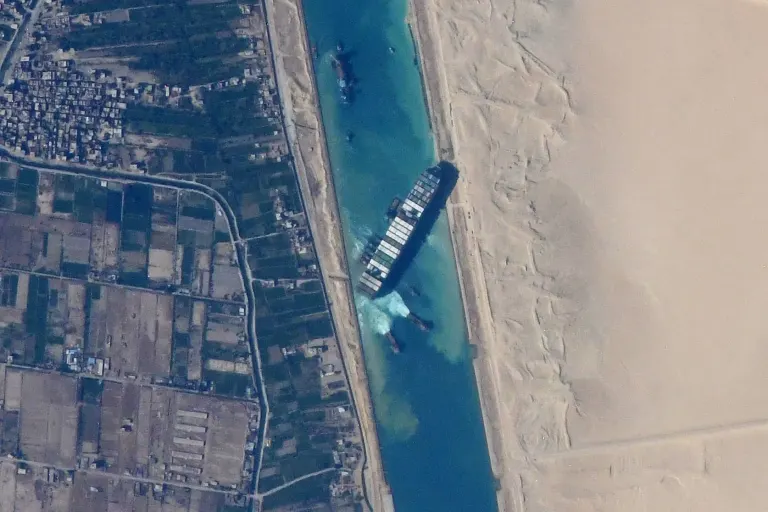
In late March 2021 the Ever Given, a 400 m, 200,000-ton container ship, ran aground in the Suez Canal and blocked it completely for six days. Most of the attention went to the trade disruption and the economic losses, but the grounding also raised questions about what it did to the canal’s ecosystem. The canal connects the Red Sea and the Mediterranean, and over 19,000 ships pass through it each year, carrying about 12% of global trade[1]. All that traffic already stresses the canal’s ecology through habitat disturbance, pollution, and the introduction of invasive species. Below I go through what studies and assessments found about water quality, wildlife, pollution, and habitat, and try to separate the short-term disturbances from anything that lasted.
Immediate effects of the blockage
The most noticeable immediate effect was a sharp rise in turbidity (how cloudy the water is), caused by the dredging and digging done to free the ship. A satellite study found that the stranded ship acted as an artificial dam in the canal, so the water on either side ended up in very different conditions[2]. North of the ship, fine sand and mud churned up by the dredgers pushed total suspended matter (TSM) to about 4 times its normal level[3]. The researchers found an abrupt, roughly fourfold increase in TSM during the blockage, with the northern part of the canal much murkier than the southern part[2][3].
Water that murky lets through far less light, which cuts photosynthesis and leaves less habitat on the canal floor for aquatic plants and algae[4]. While the blockage lasted, the cloudy water would have stressed fish and invertebrates that depend on clear water to feed and find their way, and it could have smothered some immobile organisms on the bottom. These effects were probably temporary. Once the dredging stopped and the ship was gone, the sediment settled and TSM levels went back to roughly where they were before the blockage[5].
Freeing the ship also damaged habitat, though only in a small area. Crews dug an estimated 30,000+ m³ of sand (over 1 million cubic feet) out from around the wedged bow[6][7]. That left a new hollow in the canal bed and permanently changed the shape of the bottom at that spot. Anything living there (worms, crustaceans, or seagrasses, for example) was probably killed or displaced, at least for a while. Excavators and tugboats also scraped the canal banks and disturbed the bottom further. Dredging in waterways like this can disrupt fragile ecosystems that have developed on the canal floor and banks[8]. Here the affected stretch was a few hundred meters of canal. Much of the Suez Canal is also dredged routinely for maintenance, so the ecosystem is used to periodic disturbance. In the Great Bitter Lake (a wider section of the canal where the Ever Given was later moved for inspection), no major fish kills or visible ecological problems were reported. That suggests the acute damage stayed close to where the ship ran aground.
The huge ship and the constant salvage work (tugboats, diggers, pumps) also brought unusual noise and turbulence to the canal. The underwater noise and vibration could have scared off fish or dolphins (if any came into the canal) and stressed marine mammals that are sensitive to sound. Shipping noise is known to harm marine wildlife: the global growth in ship traffic has raised ocean noise levels and made it harder for whales and dolphins to communicate and navigate[9]. For the six days of the blockage, though, the usually busy canal had no normal ship transits, which may have meant less routine noise and fewer collisions for marine life in the canal. That benefit was probably cancelled out by the loud salvage machinery in one spot and the crowds of idling ships at both ends of the canal. Once traffic resumed, marine animals probably went back to their normal patterns fairly quickly.
Pollution, waste, and emissions
The grounding did not cause any major chemical spill. A maritime risk analysis by Marsh reported “no fire or pollution” from the ship during the ordeal[10]. The hull stayed intact, so none of the ship’s fuel leaked. As a precaution, salvors moved fuel between tanks or removed it to lighten the ship, and about 9,000 tonnes of ballast water were pumped out to reduce its weight[7]. That ballast water was presumably released into the canal, but its effect was probably minor. Ships exchange ballast water all the time, and here it was mostly canal water being moved around (any organisms or sediment in it would just mix back into the same water). Fears about hazardous cargo also turned out to be unfounded. The Ever Given was mainly carrying consumer goods, not chemicals, and none of the cargo was dumped or damaged.
Over 350 vessels queued at both ends of the canal, in the Red Sea and the Mediterranean, and many of them idled for days while dealing with their own waste and emissions. Some (including at least 20 ships carrying live farm animals) urgently needed to get rid of waste or dead livestock, which raised concerns about organic pollution if any of it was dumped overboard[11][12]. No large-scale discharges were documented, and most ships probably kept their waste on board until they could pass through. Dozens of engines running at anchor, emitting sulfur and particulate matter, may also have worsened air quality around the canal until the convoy got moving. Because the blockage was short, the risks from ship waste and exhaust stayed small.
On a global scale, the bigger footprint came from ships diverting around Africa, a much longer route. An estimated 160 ships rerouted, each burning tons of extra heavy fuel oil. One analysis calculated that the detours and the effort to catch up at ports used an extra 550 million liters of fuel and emitted about 1.74 billion kilograms of CO₂ beyond normal operations[13][14]. Those emissions add to climate change, a slow and diffuse environmental impact. They do not directly affect wildlife in the Suez Canal, though the detours may have stressed wildlife along the alternate routes.
Water flow and invasive species
Though man-made, the Suez Canal is a biologically active environment, home to plankton, fish, bottom-dwelling invertebrates, and some aquatic plants in the Bitter Lakes. The murky water from dredging would have slowed phytoplankton growth and could have harmed filter-feeding animals. The same satellite study found that the stuck Ever Given significantly impeded water exchange between the Red Sea and Mediterranean sides of the canal[15][16]. That could have shifted salinity or nutrients on either side of the “wall” the ship created, and for the organisms in the canal it meant six days without normal water circulation. Once the ship was refloated, water flow and quality returned to normal. Egyptian officials did not report fish die-offs or drastic changes in the canal’s plant and animal life after the incident.
The Suez Canal has long allowed a one-way migration of Red Sea species into the Mediterranean, known as Lessepsian migration. Over 400 non-native species have entered the Mediterranean through the Suez, including jellyfish and lionfish that have driven some native species toward extinction and dramatically altered ecosystems[17][18]. This is a permanent effect of the canal itself on where marine species live, and it has sped up since the canal was expanded in 2015[19][20].
The stuck ship may have been a brief barrier to free-swimming animals, but the water was still connected around the hull (underneath it or through gaps), so some small-scale exchange of plankton or larvae may have continued. The main ways people spread invasive species, ships’ ballast water and biofouling, stopped during the blockage and started again immediately after[21]. Ballast water often carries plankton and larvae from elsewhere, which are then discharged into new waters[21]. With hundreds of ships stalled and then rushing through, any temporary drop in that transfer was quickly made up by the surge in traffic after the crisis. Most invasions are gradual and continuous anyway, so a one-week pause did not measurably change their course. Invasive populations in the Mediterranean are already established and spreading because of warming seas and the canal’s existence[22][23].
The canal’s longer-term response to the incident was a plan to widen and deepen its southern part by 2023[24][25]. That would make the canal easier to pass through, and it could permanently increase the flow of invasive species if nothing is done to limit it.
Short-term and lasting effects
The murky water and the habitat damage from the salvage work[5] probably faded within days or weeks of the ship being freed, as marine life came back or was replaced by new recruits from nearby waters. Studies and assessments up to 2025 have not found lasting ecological changes in the Suez Canal caused by the blockage, and no local extinctions or persistent water quality problems have been attributed to it. The canal’s plants and animals went back to their usual state, which is already one of constant flux because of the shipping. Marsh’s risk analysis called the incident an environmental “near miss”: little damage was done to the canal or the ship, and no pollutants were released[10].
The changes that will last are mostly physical. The spot where the ship grounded was dredged deeper, and the Suez Canal Authority then sped up its infrastructure upgrades (extending a second channel and widening parts of the canal)[24]. A deeper canal may change local currents or salinity gradients. A wider channel also gives water (and organisms) a larger cross-section to flow through, which could gradually affect habitat conditions. Those effects come from the policy of expanding the canal, not from the six-day grounding itself.
The other lasting effect is indirect. The heavy fuel burned on the detours left a permanent climate footprint, on the order of 1.7 million tonnes of CO₂[14]. That is a small push on the climate system, and the climate impact of one shipping mishap can’t be isolated. Over decades, though, climate change can affect regional ecosystems (for example by warming the Mediterranean and helping invasive species).
Environmental experts point out that the everyday effects of normal shipping are far larger than the acute effects of the Ever Given incident. The canal still brings in alien species daily, along with the ballast water and pollutants discharged by the hundreds of ships passing through[20][21]. The swarms of invasive jellyfish and lionfish now thriving in the Mediterranean are a direct result of the canal’s existence[26][22]. Had the accident involved a major oil spill or a longer blockage, the permanent ecological damage could have been far worse.
Sources
[1] [10] Ever Given: A catastrophic incident or near miss | Marsh
[2] [3] [4] [5] [6] [15] [16] Sentinel-2 Reveals Abrupt Increment of Total Suspended Matter While Ever Given Ship Blocked the Suez Canal
[7] 2021 Suez Canal obstruction - Wikipedia
[8] Suez Canal Aftermath: Time to Question the Environmental and Social impacts of Our Megaship Mania | corpwatch
[9] It took the Suez Canal crisis to highlight the scale of the polluting shipping sector
[11] [12] Suez Canal Blockage Highlights Plight of Farm Animals at Sea | Animal Welfare Institute
[13] [14] A world loss event - EVER GIVEN - GrECo risk and insurance management
[17] [18] [19] [22] [23] [26] Experts say Mediterranean Sea altered by Suez Canal’s invasive species
[20] [21] Impact of the Suez Canal on Mediterranean biodiversity - UBC Wiki
[24] [25] Suez Canal to dredge section where Ever Given grounded - SAFETY4SEA