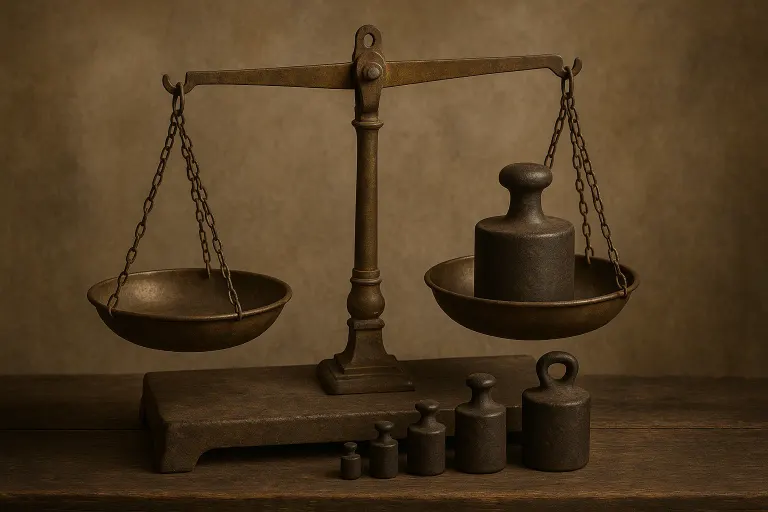
TL;DR
How weights and scales were standardized, from ancient Mesopotamia to the metric system. Mesopotamia, Egypt, the Indus Valley, China, Greece, and Rome each set up systems to keep trade and taxes fair, often backed by law and official inspectors. In the medieval period, Islamic muhtasibs, European rulers, town officials, and guilds tried to keep weights consistent despite local variation, and trade fairs set common standards for merchants from many regions. In the early modern era, growing global trade and new science pushed toward universal standards, and the metric system became the first international standard.
Ancient civilizations
Mesopotamia: city standards and Akkadian units
In Early Dynastic Sumer, each city-state had its own weight standards and units, which complicated trade between cities[1]. Unification began around 2330 BCE, when Sargon of Akkad set up a common system across his empire, and his grandson Naram-Sin later refined it[1]. The Akkadian standards introduced uniform units such as the shekel (about 8.4 g) and the mina (60 shekels), used for weighing grain, wool, or silver[2][3].
Under the Code of Hammurabi (c. 1754 BCE), a merchant who used false weights or scales to cheat buyers could be fined and publicly expelled from the marketplace[4]. Surviving cuneiform tablets and administrative records show that Mesopotamian authorities kept official reference weights. Temple or palace workshops, for instance, produced standardized stone weights (often of polished hematite, or carved into shapes like animals) that merchants could calibrate their balances against[5][6]. As trade expanded, the classical Babylonian system (1 talent = 60 mina = 3600 shekels) spread beyond the region and influenced Hebrew, Persian, and other Near Eastern metrologies[7].
Mesopotamians mostly used equal-arm balance scales: a beam hung from its center with a pan at each end. Calibration meant adjusting the empty pans until they balanced, then using known weights to measure goods. With standardized reference weights (like the duck-shaped stones and lion weights unearthed at Nimrud), traders and officials could check their scales by balancing them against the official weight in one pan[10]. That kept measurements consistent within a city, or across regions that honored the same standard, but over long distances it was harder. The Akkadian and later Babylonian administrations dealt with this by distributing official weights and requiring merchants to have their weights checked periodically, an early form of regulatory inspection[4].
Egypt and the deben
The main weight unit of pharaonic Egypt, the deben, was fairly small at first: about 13.6 g during the Old and Middle Kingdoms, which suited precious goods like gold[11][12]. By the New Kingdom (c. 1550 to 1069 BCE), the Egyptians had redefined the deben to a much heavier value of about 91 g[11][12], possibly to make it easier to weigh bulk commodities such as copper and grain. Ten qedet (or kite) made one deben, and these units appear in accounting texts and tomb inscriptions. The Theban tomb of Kenamun (18th Dynasty), for example, has a scene of Syrian merchants weighing ingots, which shows balance scales in use in international trade[13].
Archaeologists have found many Egyptian weights, often of hard stone or faience, inscribed with their stated mass and sometimes with the names or titles of officials, which indicates they were authoritative standards for calibrating scales. One is a green-glazed faience weight from Abydos, inscribed for the high steward Aabeni (late Middle Kingdom) and marked “50 qedet”[14][15]. Weights like this were probably kept in temples or administrative centers as the reference that traders had to compare their own weights against. By about 500 BCE (during the period of Persian rule in Egypt), Greek observers noted that Egyptian markets, like those in Athens, had central depositories of weights[10].


A merchant or scribe would periodically test his scales by putting the standard in one pan and adjusting the scale, or comparing goods in the other pan, until the balance levelled. If something was off, the scale could be recalibrated or the merchant’s weights trimmed or replaced. Honest weights were a moral and legal expectation. Egyptian literature and legal texts (and later Ptolemaic decrees) stress fair dealing, and a New Kingdom papyrus tells merchants “do not falsify the scales”.
Under a strong central government, pharaonic Egypt kept its weights consistent internally across a large territory for over two millennia. Royal decrees probably fixed the size of the deben and required provincial officials to enforce it, and the bureaucracy measured and distributed staples (grain rations, metal ingots) using standardized weights. Standards still changed over time with the regime or with practical needs, as the deben did. Merchants trading with Nubia, the Levant and other neighbors often had to use local units or convert by ratio. The “shekel of the sanctuary” mentioned in the Bible, for example, may have been an attempt to standardize weights in trade between Canaan and Egypt[7].
The Indus Valley and early India
The Indus Valley Civilization (2600 to 1900 BCE) developed one of the earliest known standardized weight systems. Excavations at sites like Mohenjo-daro and Harappa have turned up carefully made chert weights in graduated sizes. They follow a binary and decimal series, with a basic unit of around 13.7 g and multiples and fractions of it (1, 2, 4, 8, 16, and so on)[16]. Over 500 of these weights have been studied, and they show little variation across different cities and levels, which points to strong central control over metrology for at least 500 years[16]. The smallest weights (around 0.85 g) were probably for precious materials, and the larger ones (up to several kilograms) for bulk goods[17][18].
The Indus people also built pan balances, known from a depiction on a clay tablet and from a bronze balance beam with two pans[19]. Consistent brick sizes and merchant seal impressions point to the same uniformity across the region, which made fair trade easier in its urban markets. When Indus weight standards spread to neighboring regions (Persia, Central Asia), they were sometimes modified[20].
Later in ancient India, the Arthashastra (c. 4th century BCE), a treatise on statecraft attributed to Kautilya (Chanakya), has a detailed chapter on the Superintendent of Weights and Measures. According to the text, the state made official weights from durable materials (stone or iron) that would not corrode or change with heat or moisture[21]. It sets out a hierarchy of weight units, from small seeds up to large masses, and even describes how to build calibrated balances. A special balance (samavrittā) of fixed length was to have a mark where it exactly balanced a known small weight (one karsha), with further marks for 1 pala, 12 palas, 20 palas and so on etched along the beam[22][23]. That is a kind of steelyard, a beam scale with marked positions for standard weights.
Every weight and measure was to be stamped with an official seal, and using unstamped (unverified) weights was an offense fined at 27¼ panas[24]. The Superintendent charged a small fee to re-certify merchants’ weights periodically by comparing them with the state’s reference standard[24]. This is one of the earliest documented examples of legal metrological control, and it works much like a modern weights-and-measures inspection. If regions within the Mauryan Empire had different traditional units, Kautilya’s rules would have helped unify them by defining standard conversions, often based on seed counts (20 rice grains = 1 dharana for diamonds, for example[25][26]).
Complete uniformity across the subcontinent was hard to sustain. Regions outside Mauryan control, or in later periods, had their own standards (Vedic texts, for instance, mention units like manas and bhar). The early efforts still carried forward: later Indian empires (Gupta, Mughal) kept official weights and measures to support taxation and trade[27][28]. The 16th-century Mughal emperor Akbar, for example, continued to use standardized weights for collecting land revenue (though mainly for area and volume measures of grain).
China: unification under the Qin
During the Zhou Dynasty and the Warring States period (before 221 BCE), each Chinese state had its own units of length and weight. That changed when Qin Shi Huang unified China in 221 BCE and decreed nationwide standard weights and measures. An edict from the first Qin Emperor’s 26th year declares that “lengths, measures, and weights that are not unified and are doubtful, [we must] clarify and unify them all”[29]. The Qin administration carried this out by abolishing the old weights of the conquered kingdoms and issuing new official standards across the empire[30].
One surviving example of the reform is an inscribed iron weight (120 jin, equal to 1 shi or “stone”) from the Qin dynasty[31]. Its inscription repeats the imperial command to unify measures and says that unification brought “great peace” to the land under Heaven[32]. Only the heaviest Qin weights were made of iron, and this one was a master standard sent to the provinces. Qin officials were strictly forbidden to use any weight that deviated from the state norm, a rule meant to prevent corruption and assert the regime’s authority[33].
The new standards made trade and tax collection much easier. Farmers could pay grain tax knowing that a “dou” or “shi” measure was the same everywhere[34]. A common system of weights and measures also reinforced the idea of a single polity. The Qin system (with units like the jin, 斤, about 250 g at the time) continued into the Han Dynasty and beyond[35]. Later dynasties changed its size considerably: from the Tang onward the jin was much heavier, roughly 590-680 g depending on the period (the Qing jin was about 596.8 g). The principle of a national standard still held. In the Han Dynasty, an official ministry kept the standard weights and sent copies to local governments. Ancient Chinese treatises on metrology and surviving weights (often bronze, inscribed with their value and the issuing authority) show how organized the system was.
Imperial edicts did not make China perfectly uniform. Remote regions sometimes kept their old units, and Chinese merchants dealing with Central Asian or Indian counterparts had to convert between the jin and foreign weight units. Still, state-controlled weights continued for millennia. Under the Ming and Qing, for example, bronze standard weights stamped with the emperor’s mark were distributed, and markets were inspected periodically. Because of this continuity, which began with the Qin, China had one of the most internally consistent systems of weights and measures in the world well into the early modern period.
Greece: city-state standards and Athenian reforms
Each of the hundreds of Greek city-states tended to have its own standard for units like the drachma (a weight unit used for silver currency) or the talent (a larger unit of roughly 25 to 30 kg, used for bulk goods). Over time some systems spread: the Athenian (Attic) standard became common in the eastern Mediterranean because of Athens’s economic influence, and the Aeginetan standard was used by others for a time[10]. Lawgivers also standardized within their own cities. Solon of Athens (early 6th century BCE) reformed the Athenian coinage, and perhaps its weights, to match the “Solonic” standard, which eased trade by making Athens’ currency (and its underlying weight unit, the drachma) compatible with other economies[10].
Greeks mostly weighed goods on balance scales with equal arms, and the larger city-states kept official reference standards to calibrate them against. By around 500 BCE, Athens had a central depository of weights and measures at the Tholos in the Agora (the civic center)[36]. Merchants were required to test their scales and weights against these official standards[36]. A trader could bring his set of weights to the Tholos, compare them with an official master weight (a mina or stater, for example), and adjust any that were wrong. This protected buyers and sellers from fraud and helped make one “mina” of grain the same in different Athenian markets.
Surviving bronze and lead weights from Greece are often marked with their unit (“ΜΝΑ” for mina, for example) and sometimes bear city insignia. In Athens some weights were even countermarked after periodic inspections. Other Greek cities had their own agoranomoi (market overseers) whose duties included checking the weights and measures in use, much like the later Roman and Islamic market inspectors[37][38].
When goods moved from one city-state to another, merchants often had to convert quantities. An Aeginetan talent was heavier than an Attic talent, for example, so traders negotiated prices with the difference in mind. Over the centuries, conquest and federation helped. Alexander the Great’s empire spread Greek units widely, and the Hellenistic kingdoms that followed used broadly uniform systems (Ptolemaic Egypt, for instance, used a variant of the Attic standard for coinage and weight). More long-distance trade in the Hellenistic period also led many cities to adopt, or at least accept, the common Hellenic weight units so that their measures were interchangeable[10]. Full uniformity never came, because of cultural inertia and local pride in measurement systems. Philosophers and later Roman-era lexicographers often list equivalent values for different cities’ units.
Rome: the libra and the steelyard
The Romans took much of their metrological system from earlier Mediterranean practice (Etruscan, Greek and so on), but under the Republic and the Empire these measures became consistent and well documented[39]. The basic Roman unit of weight was the libra (Roman pound), about 327 to 329 g[40]. The libra was divided into 12 uncia (ounces), and the ounce into smaller scruples. That duodecimal division persisted, and the English word “ounce” still echoes it.
Because Roman commerce and administration were so large, the government regulated weights and measures. An official set of standard weights was probably kept in the Temple of Jupiter in Rome, and provincial governors were expected to enforce Roman standards. A 4th-century AD bronze modius (a vessel for measuring grain) found in Gaul has an inscription acknowledging imperial regulation of weights and measures, which implies it was calibrated to the official standard and authorized by the Emperor[39]. Many standardized vessels and weights like it were made to collect taxes and keep trade fair across the empire.
Alongside the traditional equal-pan balance (Latin libra, the same word as the weight unit), the Romans popularized the steelyard (statera in Latin). A steelyard is a lever scale with unequal arms. The load hangs near the short end, and a small counterweight slides along the graduated long arm until the beam balances[41][42]. The counterweight’s position gives the weight of the object. The device was easy to calibrate by marking the arm where the counterweight balanced known reference masses. There is evidence of simple steelyards in the Near East earlier, but the Romans (and, at roughly the same time, the Han Chinese) developed them independently and adopted them widely around the 2nd century BCE[43]. Steelyards were useful for weighing larger loads (sacks of grain, amphorae of wine) with a single handheld instrument. Many have been excavated across the Roman Empire, including several at Pompeii that were preserved by the volcanic ash. Because a steelyard was portable and marked in Roman units, a trader could weigh goods in Spain or Syria and trust the result even where the local units differed.
Roman law punished fraud (the Twelve Tables and later edicts forbade deceitful weights). In towns, aediles (market magistrates) inspected vendors’ weights and scales, much as the Greek agoranomoi did. A merchant selling in a forum might have his bronze weights checked against the town’s standard set, and cities like Pompeii kept standardized weights in public offices. Official weights often had identifying marks: some surviving bronze weights from the imperial period are stamped “EX AG” (ex actis, “from the records”) or with the mark of a censor’s office, to show they had been verified.
In the eastern provinces, Greek and native units stayed in use alongside Roman ones for a long time. Roman currency did become uniform (denarii, solidi and so on, which in effect enforced weight standards for gold and silver), but in local markets people might still talk about old Syrian minas or Egyptian debens. The empire mostly tolerated this as long as the local units could be related to the Roman system (in a given place, an administrative ruling might set 1 Greek (Attic) mina equal to 1⅓ Roman pounds). Rome’s ambitions to standardize every local measure seem to have been modest. The “Weights and Measures” chapter of Mosaics of Knowledge describes standardization efforts in the Roman world as “weak at the local level and weaker still at grander scales”[45]. Merchants and officials had to work in both systems: a trader shipping grain from Alexandria to Rome had to convert Egyptian artabas to Roman modii. Imperial edicts sometimes gave the conversion rates. After the empire, European kingdoms based their systems on modified Roman units, and later civilizations built on the records, tables of weights and high-precision scales that Rome left behind[39].
The medieval period
The Islamic world and the muhtasib
In the medieval Islamic world, weights and measures were a religious matter as well as an economic one. The Quran tells believers to “give full measure and weight, in justice” and condemns cheating in measure (Qur’an 83:1-3). This moral rule became an institution through the office of the muḥtasib, a market inspector charged with keeping trade fair, which built on earlier traditions of state control over weights[37]. From the early Caliphates (7th and 8th centuries) through the later Islamic empires, muhtasibs had the power to inspect markets, check weights and scales, and punish merchants who cheated[38][46]. According to historical manuals of ḥisba (market regulation), a muhtasib made sure that loaves of bread had the standard weight for their price, that butchers used proper weights, and that all measuring devices were accurate and certified[38][47]. By around 1500 CE, the muhtasib’s role had narrowed almost entirely to weights, measures, and commercial honesty[48][49].
Islamic states often took over or adapted the weight standards of earlier cultures and gave them new definitions. One main unit was the mithqāl (about 4.25 g), traditionally the weight of a gold dinar coin (itself originally based on the Byzantine solidus). Another common unit was the dirham (the weight of the silver coin, about 2.97 g). Because minting was centralized, these coin-based units were fairly uniform across the Caliphate. The Umayyad and Abbasid caliphs made sure that a dinar in Spain weighed the same as one in Baghdad[50]. Larger commercial units like the raṭl (pound) did vary by region (a raṭl in Cairo might be about 450 g, in Aleppo about 320 g), which made trade between regions harder. Conversion tables existed, though, and the legal standards in each place were often documented. Scholarly works (like al-Bīrūnī’s 11th-century book on precious stones) often listed equivalent weights in different cities. Some caliphs tried to unify these units: the Abbasid caliph al-Ma’mun reportedly tried to standardize the raṭl across his domains, with limited success.
In cities like Cairo and Damascus, muhtasibs kept official standard weights (often in the treasury or a mosque). Merchants had to have their weights compared with these and stamped if correct, much as the Arthashastra required in India[24]. A merchant caught with unstamped or false weights could be fined or even corporally punished. An account from Mamluk Egypt (14th century) describes the muhtasib watching transactions from a high platform in the market, and those found cheating with light weights were whipped and paraded in humiliation[46]. Manuals for muhtasibs (like Ibn al-Ukhuwwa’s 13th-century treatise) describe common tricks in detail, such as hollowing out weights or pressing a hidden thumb on the scale, and explain how to detect them[46].
The muhtasib could order scales recalibrated or weights remade if they were out of tolerance[51]. There was even a kind of metrological workshop, the Dār al-ʿIyār, where official weights and measures were made and tested under government supervision[52].
At their height the caliphates stretched from Spain to Central Asia, and their regions had inherited different pre-Islamic systems (Persian, Byzantine, Berber and others). The early caliphs mostly left these alone, and more effort went into harmonizing them as government consolidated. By the 10th century, the Abbasids had settled on a standard set of units (such as the Baghdad ratl, and the cārah for volume) that influenced the eastern Islamic world. The west (al-Andalus and the Maghreb) kept slightly different standards. The underlying approach was the same everywhere: each market should have a single, agreed set of measures.
Caravans on the Silk Road and merchants in the Indian Ocean trade had to move between Chinese, Indian, Islamic and European systems. Muslim traders were skilled at this, and cosmopolitan trading hubs like Cairo, Baghdad and Samarkand often kept sets of foreign weights for reference (much as modern customs offices might). Political fragmentation, such as the rise of independent sultanates, sometimes introduced new local standards, but Islamic law and the shared institution of the muhtasib kept a baseline of fairness. When the Ottoman Empire codified its laws, it kept the office of the muhtesip (Turkish for muhtasib) and carefully defined the official okka (the Ottoman pound) and other units for all provinces.
Medieval Europe: local pounds and royal standards
After the fall of Rome, European feudal states, kingdoms and even single towns developed their own standards for weights and measures. A “pound” (Latin libra) in one region could differ from a pound in another by ounces. In 13th-century Europe, for example, several pounds were in use at the same time: the Tower pound in England (about 349 g), the Parisian livre (about 489 g), and the Cologne mark weight (about 233 g, for a half-pound). The patchwork reflected the politics of medieval Europe, where no single authority enforced uniformity across the continent.
Merchants traveling from one market to another had to know the local units, and often used conversion tables or carried standardized sets of weights to compare. Moneylenders and traders got good at calculating equivalents (how many pounds of Barcelona made a Venetian libra, for instance). This complexity is one reason international trade in the Middle Ages was often handled by specialists who understood the differences.
Kings and city councils did try to standardize within their own realms, since common measures made trade easier and reduced disputes. In England, King Henry I (12th century) was said to have defined the royal yard and perhaps a royal pound. In 1215, Magna Carta included a clause (chapter 35) stating: “Let there be one measure of wine throughout our whole realm, and one measure of ale, and one measure of corn… and one breadth of cloth… and let it be the same for weights as for measures”[53]. In effect this was a demand for national standardization in England, and it reflects how common abuses of weights and measures had become by then[53].
A few decades later, a long royal ordinance known as the Assize of Weights and Measures (c. mid-13th century, often attributed to the reign of Henry III or Edward I) set out a detailed list of English units and how they related[53]. It defined, for example, 1 yard as 3 feet, each foot as 12 inches, and the inch as 3 grains of barley, dry and round, placed end to end[54]. It also confirmed the standard pound and smaller units of weight. These standards were successful enough to stay in force in England for centuries[55].
On the Continent, the Holy Roman Emperors at times tried to impose uniform units (Charles IV’s Golden Bull of 1356 called for uniform coinage and implied uniform measures, though this was never fully carried out). In France, King Philip II (12th century) introduced the poids de marc as a royal standard for weight. City-states and leagues acted too. The Hanseatic League was a federation of trading cities around the North and Baltic Seas in the 14th and 15th centuries. It had its own agreed weight (the Hanseatic pound) for trade between its cities, so they did not have to keep converting. Its trading post in London was called the Steelyard (the Stilliard, from the German Stalhof), and the English name of the steelyard balance is often said to come from it[56].
Enforcement in medieval Europe was usually local. Town charters often mention an official called the Weightmaster or Clerk of the Market, who checked merchants’ weights and fined fraud. Guilds (associations of craftsmen and merchants) added another layer of control. Baker guilds in England, for instance, were subject to the Assize of Bread and Ale, which tied the weight of a standard loaf to the price of wheat. Inspectors periodically weighed bakers’ loaves, and short-weight bread could mean fines or even the public pillory for the baker. This indirectly enforced proper weight standards for flour and for weighing in general. Some markets kept standardized weights on site (a town hall might keep a standard 1-pound weight chained to the wall), so a customer who doubted a purchase could check the seller’s weights against the official one.
A merchant moving goods from Genoa to Bruges, say, had to deal with at least two or three weight systems along the way. Dishonest dealers could use unit conversions to cheat counterparts who didn’t know the local system. To reduce both problems, some international trade fairs (like the Champagne Fairs in 12th- and 13th-century France) set their own fair standards, since merchants came to them from many regions and needed a common measure. Troyes, a major fair town, gave its name to the troy weight system used for precious metals, and the English troy pound (used for gold, silver, and apothecary weight) probably derives from the pound of Troyes[57]. Goods sold in bulk by weight at the fairs (wool, salt, spices) were measured in the avoirdupois system, from Old French avoir de pois (“goods of weight”)[57]. England later adopted avoirdupois (16 ounces to the pound) for everyday goods while keeping troy (12 ounces to the pound) for bullion[57]. Trade had shaped English standards, and it left one country with two weight systems, which Britain kept until the 19th century.
By the late medieval period (15th century), stronger states brought more regional standardization. The unification of Spain under Ferdinand and Isabella, for example, led to the various medieval Spanish weight systems being harmonized into a Castilian standard. Similarly, the Weights and Measures Act of 1496 in England under Henry VII reaffirmed national standards and distributed new physical standard weights and measures throughout the shires (earlier standards had literally been lost in civil wars)[58]. Europe was still far from uniform in the 18th century, though: a German encyclopedia of eighteenth-century measures lists hundreds of local variants of the pound, the foot and other units.
The early modern period
By the early modern period (c. 1500 to 1800), exploration and scientific progress were pushing for standard weights on a wider scale. Global trade grew enormously as Europeans reached Asia and the Americas, bringing together civilizations with entirely different measurement traditions. A Spanish galleon might carry goods measured in Spanish libras to Manila, where they’d be sold in Chinese jin. An English East India Company agent in India had to convert English pounds into local seer or tola units. This made the old problem of mismatched standards between cultures worse. To reduce confusion (and losses), traders often carried reference weight sets or conversion charts, and some negotiated contracts in abstract standard units agreed on beforehand. Conversions still left plenty of room for error and fraud. In the 17th century the Dutch East India Company set up its own standard weights in its trading posts so that a pound of spices in Batavia was the same as the pound expected in Amsterdam.
Within Europe, nation-states became more centralized and bureaucratic, which made stricter enforcement of internal uniformity possible, and weights and measures acts were updated periodically. England renewed its standards in 1496, 1588, and 1758, each time reaffirming or adjusting the definitions (often because of better scientific determinations of the physical standards)[58]. France under King Louis XIV made the poids de marc (a Parisian pound of 2 marcs) the legal weight for the realm. Old regional units persisted anyway. France on the eve of its Revolution (1789) is the classic example: despite royal ordinances, it had hundreds of local units of weight and measure. Even units with the same name (like the “livre” for pound) varied slightly from Paris to Provence. The situation was common across Europe and got in the way of commerce and taxation.
The scientific revolution of the 17th century brought calls for a universal system based on nature. John Wilkins in England (a founding member of the Royal Society), among others, proposed around 1668 a universal system of measures in which length, volume and mass would be interrelated and decimal. In effect it was an early version of the metric system. The scheme was never implemented, but more and more scholars came to think that rational standardization was both possible and desirable. Measurement was fundamental to the new science (Galileo, Newton and others needed consistent units to express laws of nature), and that put pressure on the old, arbitrary systems.
Governments also wanted uniform standards for practical reasons: easier tax assessment and economic development. The Habsburg Empress Maria Theresa, for instance, reformed weights and measures in her realms in the 18th century and created the Maria Theresa pound standard. In the newly independent U.S., the Constitution (1787) gave Congress the power to fix the standard of weights and measures.
Enforcement became more organized, and many countries set up dedicated offices for weights and measures. In Britain, the Board of Trade eventually took on this role, and in France the Contrôle général des poids et mesures existed even before the Revolution. In Islamic regions the muhtasib still operated (the Ottoman Empire had them until its 19th-century reforms). Governments enforced standards through custom houses, market inspectors, and state-sanctioned metrological laboratories that calibrated and distributed standard weights. The tools had changed: more precise balances, early scientific spring scales by the late 18th century, and print, which allowed official standards and conversion tables to be published widely.
By the 1770s in England, all official business had to use the standard avoirdupois and troy weights defined in London. A merchant in a provincial town who used an off-standard local “customary” weight could face penalties. Inspection certificates became commonplace, and some weights carried the stamp of King George’s royal cypher to show they had been verified. The remaining obstacles were mostly inertia and international differences. People were used to their local measures (a farmer might trust the old familiar unit over a royal edict). Different empires were proud of their own standards (the British imperial system versus the Spanish versus the Chinese, and so on). Breaking those habits often took a political revolution or a strong economic incentive.
International trading companies and treaties sometimes set common standards (British and Dutch agreements in trading posts, for instance, would specify which weight system to use to avoid disputes). Legal reforms within countries harmonized domestic commerce, which in turn made international standardization easier, because each country now spoke largely with “one voice” on units.
The French Revolution introduced the metric system in 1795, right at the end of this period. It was designed to replace the many traditional units with one decimal system based on natural constants, with the kilogram as the unit of mass and a prototype kilogram weight (a platinum cylinder) as the ultimate standard. Many nations followed France in the 19th century. With later international agreements such as the 1875 Treaty of the Meter, the world finally had a single framework that solved the problem of mismatched standards over long distances.
Sources
[1] [2] [3] [7] Ancient Mesopotamian units of measurement - Wikipedia
[4] The Code of Hammurabi | Ancient Blueprint for Governance and Accountability – Complytek
[5] [6] [13] Expedition Magazine | Hanging in the Balance: Precision Weighing in Antiquity
[8] [9] Assyrian lion weights - Wikipedia
[10] [36] Ancient Greek units of measurement - Wikipedia
[11] [12] Ancient Egyptian units of measurement - Wikipedia
[14] [15] File:Green glazed faience weight, inscribed for the high Steward Aabeni. Late Middle Kingdom. From Abydos, Egypt. The Petrie Museum of Egyptian Archaeology, London.jpg - Wikimedia Commons

[16] [17] [18] [19] [20] [27] [28] History of measurement systems in India - Wikipedia
[21] [22] [23] [24] [25] [26] The Superintendent of Weights and Measures [Chapter 19]
[29] [31] [32] [33] [34] Inscribed Weight - China - Qin dynasty (221–206 BC) - The Metropolitan Museum of Art
[30] Qin Dynasty Weight with Qin Shihuang’s 26th Year’s Edict
[35] Qin dynasty (221–206 BCE)
[37] [38] [46] [47] [48] [49] Muhtasib - Wikipedia
[39] Ancient Roman units of measurement - Wikipedia
[40] Roman Weights and Measures – Lucius’€™ Romans - Kent blogs
[41] [42] [43] [44] [56] Steelyard balance - Wikipedia
[45] Weights and Measures | Mosaics of Knowledge - Oxford Academic
[50] WEIGHTS AND MEASURES i. PRE-ISLAMIC PERIOD
[51] SOME ASPECTS OF AL-ASADĪ’S ECONOMICS - jstor
[52] [PDF] The Islamic Science of Weights and Balances - Muslim Heritage
[53] [54] [55] [57] Measurement system - English, US Customary, Weights & Measures | Britannica
[58] Medieval weights and measures - Wikipedia